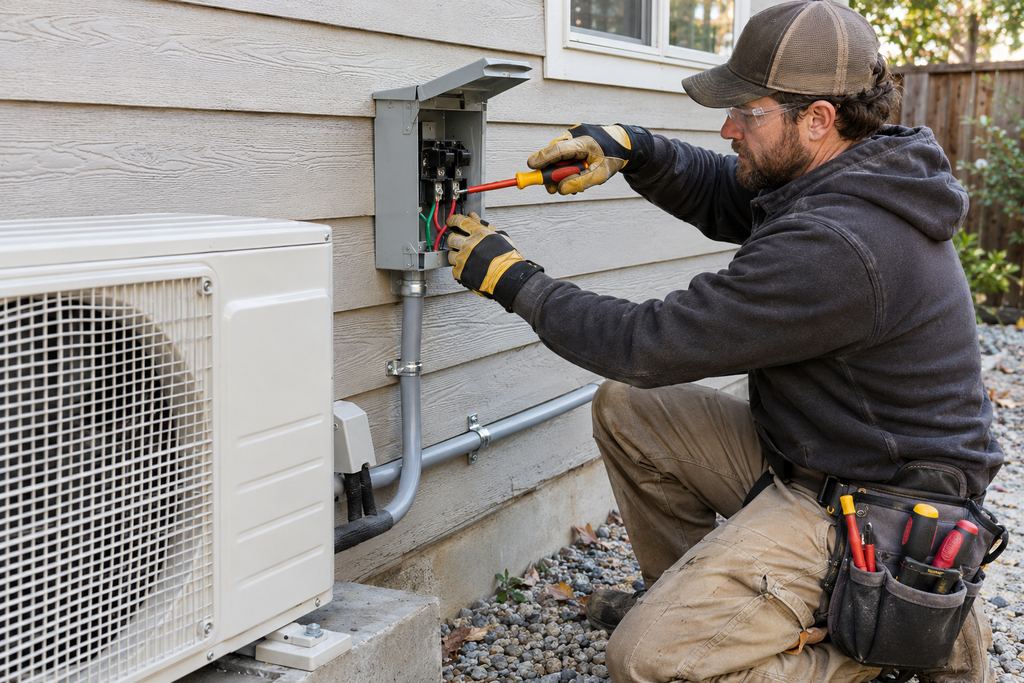
Mini Split Electrical Requirements
Mini split electrical requirements come from the unit's nameplate, not from its BTU rating alone. Most systems need their own circuit at 115 or 208/230 volts, a breaker no larger than the listed maximum, wire sized to the listed minimum ampacity, and a disconnect within sight of the outdoor unit.
Sending your request
Please keep this page open. The form is locked so the request is not sent twice.
Your request was received
We passed it to an installer in your area. If one accepts, they contact you using the phone number or email you gave. We cannot say how soon, and you are not required to hire anyone.
No reply after a few days? Check your spam folder, then use the contact page.
Short answer
Small single-zone units are sold in 115-volt and 208/230-volt versions, while larger units and most multi-zone outdoor units run on 208/230 volts. The outdoor unit's label lists MCA (minimum circuit ampacity) and MOP or MOCP (maximum overcurrent protection); the wire is chosen from the first number and the breaker cannot exceed the second. Local code decides who may do the panel work and whether a permit is needed.
Start with the nameplate, not a chart
Every outdoor unit carries a rating label, and the installation manual for that exact model repeats the same values. Treat the label and the manual as the primary source for your circuit; a chart for another model is not. Three lines matter for the circuit:
- Rated voltage and phase. Residential units are single phase, usually 115 V or 208/230 V.
- MCA, minimum circuit ampacity. The conductors feeding the unit must carry at least this current.
- MOP or MOCP, maximum overcurrent protection. The breaker or fuse may be smaller than this, down to what the unit needs to start, but never larger.
Two systems with the same 12,000 BTU capacity can list different numbers, because compressor and fan designs differ. That is why forum answers that give one breaker size for every unit are unreliable. Ask the installer to send the model number before the electrician quotes, so the circuit matches the equipment that will actually be hung on the wall.
115 volt or 208/230 volt
Both voltages work. The choice follows the model and what your panel can supply.
| Question | 115-volt units | 208/230-volt units |
|---|---|---|
| Where they show up | Smaller single-zone models, often marketed for one room | Most single-zone sizes and nearly all multi-zone outdoor units |
| Current at the same capacity | Roughly double, because the voltage is half | Lower, so the wire and breaker can be smaller |
| Panel space | One breaker space | A two-pole breaker, so two spaces |
| Can it use an existing outlet? | Only if the maker allows it and the circuit is dedicated and sized for it; most are hardwired | No, a dedicated 240-volt circuit is run |
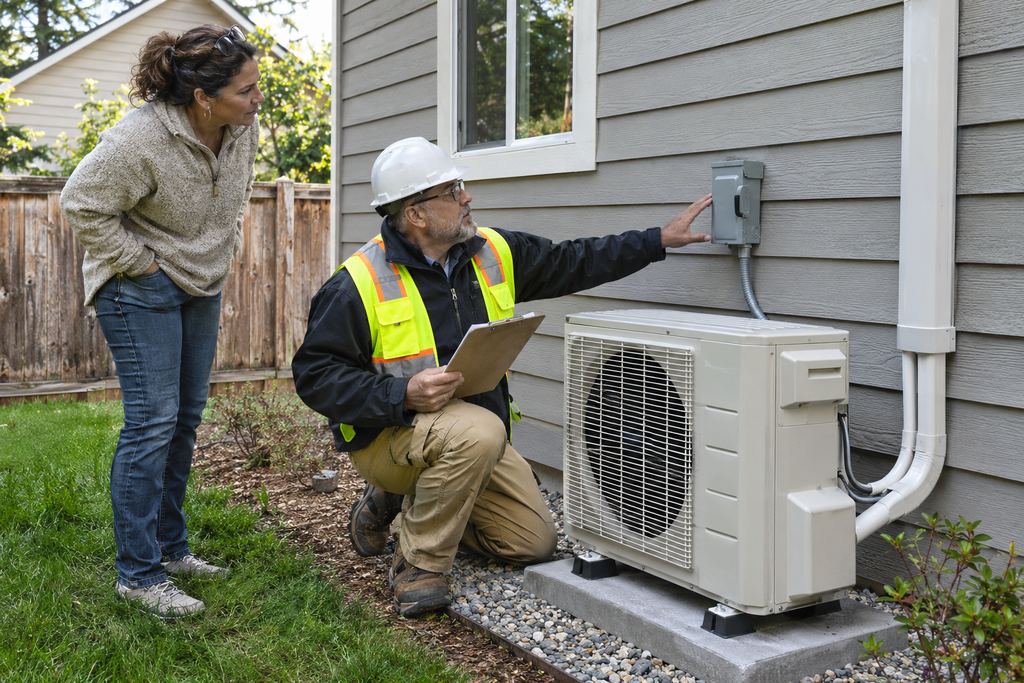
Parts of a typical mini split electrical installation
- Dedicated branch circuitA breaker and conductors that feed only the mini split. Sharing a circuit with outlets or lights is not allowed by most manuals.
- Outdoor disconnectA switch box mounted within sight of the outdoor unit so a technician can cut power while working. A pull-out or switch type is common; some makers call for a fused disconnect.
- Whip to the unitA short run of liquid-tight flexible conduit from the disconnect to the outdoor unit's terminal block.
- Interconnect cableOn most ductless systems the indoor head is powered and controlled through a cable from the outdoor unit. The manual specifies the conductor count, gauge and whether it must be stranded.
- GroundingAn equipment ground runs with the circuit and the interconnect, per the National Electrical Code and the manual.
- Breaker typeSome labels call for an HACR-rated breaker or time-delay fuses. The electrician matches what the label states.
How wire size is chosen
The usual pairing many homeowners know, 14 gauge copper on 15 amps, 12 gauge on 20 and 10 gauge on 30, is a starting point for general circuits. Air conditioning equipment follows its own article in the National Electrical Code (NFPA 70), and the breaker on an AC circuit may legally be larger than that pairing suggests when the nameplate allows it. The electrician sizes conductors from the MCA, then checks run length, conductor material and how the cable is routed. A long run through a hot attic can call for a heavier gauge than the short answer online.
The interconnect between indoor and outdoor units is a separate cable. Brands specify it differently, and a wrong or spliced cable is a common cause of communication error codes on new installs.
Will your panel handle it?
A single-zone inverter unit is a modest load compared with a central AC or electric range, but it still needs free breaker space and capacity on the service. Before quoting, an electrician typically looks at:
- open spaces in the panel, since a 240-volt unit needs a two-pole breaker;
- the service size and what already runs on it, such as an electric dryer, water heater, EV charger or well pump;
- the distance from the panel to the outdoor unit location, which drives wire cost;
- whether a subpanel near a garage or addition makes more sense than a long home run.
A full panel does not automatically mean a service upgrade. Sometimes the fix is rearranging circuits or adding a subpanel, and sometimes the load calculation shows the service is too small. That call belongs to a licensed electrician on site.
What you can check and what goes to an electrician
Safe checks you can do
Only checks from the owner's manual that need no tools and no access inside the units.
- Write down the model numbers of the indoor and outdoor units and photograph the rating label.
- Photograph the panel door label and the breaker layout so the electrician can quote remotely.
- Measure the rough distance from the panel to where the outdoor unit will sit.
- After installation, if the unit stops, check that the breaker has not tripped and reset it once. If it trips again, leave it off and call.
Leave these to a professional
Refrigerant handling, flaring or brazing the line set, electrical connections and pressure or vacuum tests need a qualified technician.
- Running the new circuit and installing the breaker.
- Mounting and wiring the outdoor disconnect and whip.
- Connecting the interconnect cable between indoor and outdoor units.
- Load calculation for the service and any panel or subpanel work.
- Pulling the electrical permit where one is required and meeting the inspector.
Do not wire it yourself
Codes, permits and GFCI questions
States and cities adopt the National Electrical Code on their own schedules and often amend it. NFPA publishes the code on its NFPA 70 page; the edition that applies to your house is the one your city or county building department enforces, so ask that office or the electrician. Recent editions added ground-fault rules for outdoor outlets, and some inspectors have applied them to HVAC equipment, which raised questions about nuisance tripping on inverter units. Whether your installation needs GFCI protection depends on the edition your jurisdiction uses and any local amendment. Ask the electrician which code edition applies and whether the permit covers both the electrical and mechanical work.
For who does what: in many areas the HVAC contractor mounts the units, connects refrigerant lines and wires the interconnect, while the branch circuit from the panel falls to a licensed electrician. Some HVAC licenses cover the whole job. Ask each bidder to state in the written estimate who is doing the electrical portion. Our page on mini split electrical installation lists what that line item usually includes.
Plan the size before the circuit
The circuit follows the equipment, so settle the capacity first. Start with what size mini split you need and the longer mini split sizing guide. If several rooms will run from one outdoor unit, a multi-zone installation usually needs one larger 208/230-volt circuit rather than several small ones. Electrical work is one of the line items that moves the total on the mini split installation cost page.
Related guides and services
Pages that continue this topic.
Questions
How many volts do you need for a mini split?
Either 115 V or 208/230 V, depending on the model. Smaller single-zone units are sold in both versions. Larger single-zone and multi-zone outdoor units are typically 208/230 V. The rating label on the outdoor unit states the voltage.
Do you need an electrician for a mini split?
In most cases, yes. The unit needs a dedicated circuit and an outdoor disconnect, and many jurisdictions require a licensed electrician and a permit for new circuits. Some HVAC contractors hold licenses that cover the electrical portion. Ask who does it before you sign.
What size breaker do I need for a 12,000 BTU mini split?
Read the MOP or MOCP value on the outdoor unit's label. On many 12,000 BTU 230-volt models it lands at 15 or 20 amps, and 115-volt versions draw more current and need a larger circuit. The breaker can never exceed the label value.
What wire runs between the indoor and outdoor unit?
An interconnect cable that carries power and communication to the indoor head on most systems. The maker specifies the conductor count and gauge. Using the wrong cable or splicing it often causes error codes.