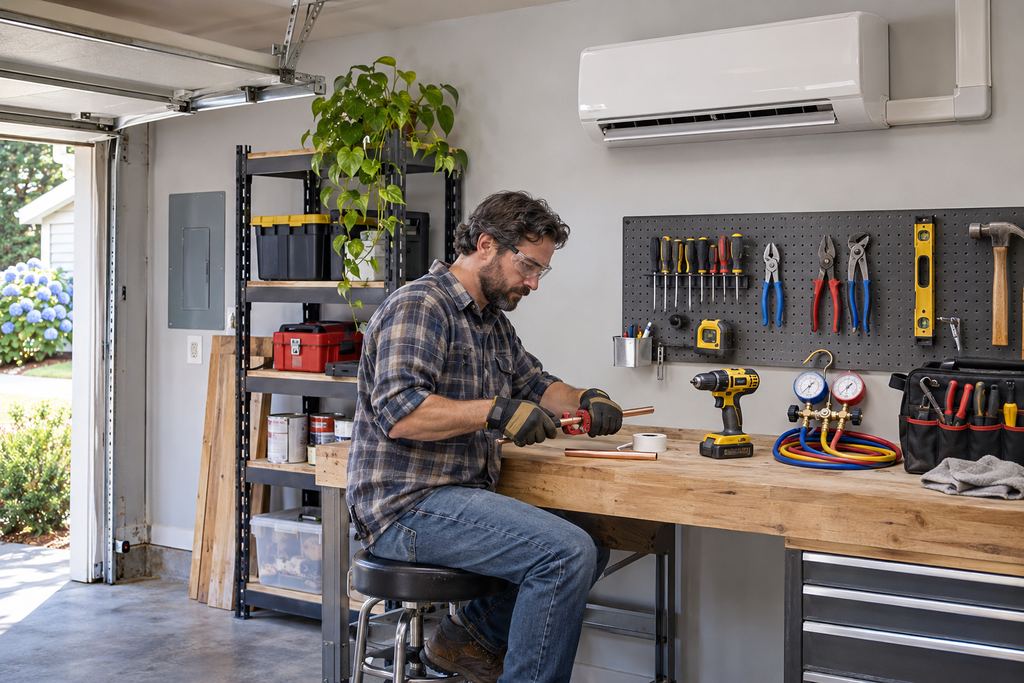
Garage Mini Split Installation
A ductless mini split is one of the more practical ways to heat and cool a garage, because it needs no ducts from the house and runs on one dedicated circuit. Before garage mini split installation, look at insulation and the garage door. In an uninsulated garage even a large unit struggles, while an insulated one can often get by with a single 12,000 to 18,000 BTU head.
Sending your request
Please keep this page open. The form is locked so the request is not sent twice.
Your request was received
We passed it to an installer in your area. If one accepts, they contact you using the phone number or email you gave. We cannot say how soon, and you are not required to hire anyone.
No reply after a few days? Check your spam folder, then use the contact page.
Is a mini split a good fit for your garage?
It usually is when the garage is used as a workshop, gym, hobby room or office, or when it is being converted to living space. The heat pump handles both seasons, the inverter compressor throttles down once the space is at temperature, and the indoor head mounts high where it stays clear of cars and benches. It is a weaker fit when the garage door opens many times a day, when the space has no insulation and none is planned, or when the only goal is to keep pipes from freezing a few nights a year.
Extending the home's central ductwork into the garage is a poor alternative in most cases. Building codes generally restrict duct openings into attached garages because of exhaust and fuel vapors, and the house system was not sized for the extra load.
Fix these before sizing
Each one shrinks the load, and some can save a size on the equipment.
- Garage doorA thin steel door is often the largest heat leak. An insulated door or a retrofit panel kit plus new bottom and side seals makes a measurable difference.
- Walls and ceilingUnfinished stud walls and an open attic above the garage let heat in and out freely. Insulation and drywall come first.
- Air leaksSeal gaps at the sill plate, around the man door and where wiring passes through.
- WindowsOld single-pane windows in a workshop add load; shading or replacing them helps in hot climates.
Rough garage sizing ranges
Rule-of-thumb ranges for planning only. A load calculation based on your insulation and climate sets the size.
| Garage | Approx. area | Insulated, mild climate | Poorly insulated or extreme climate |
|---|---|---|---|
| One-car | 250 to 300 sq ft | 9,000 to 12,000 BTU | 12,000 to 18,000 BTU |
| Two-car, 24 by 24 | about 576 sq ft | 12,000 to 18,000 BTU | 18,000 to 24,000 BTU |
| Three-car | 750 to 900 sq ft | 18,000 to 24,000 BTU | 24,000 BTU or two heads |
Equipment choices for a garage
- Single-zone wall headThe usual choice. One indoor unit, one outdoor unit and one line set through the garage wall.
- Zone on a multi-zone systemIf the house is getting a multi-zone system, the garage can be one head. The garage load swings more than a bedroom, so some installers prefer a separate single zone.
- Ceiling cassette or ducted unitUseful in a finished garage conversion where wall space is taken by cabinets. A concealed duct unit can go above a dropped ceiling.
- Pre-charged DIY kitSold with sealed quick-connect line sets. Line length is fixed, warranty terms vary by maker, EPA guidance on connecting pre-charged lines still applies, and the circuit and disconnect follow local electrical code.
Where to put the indoor and outdoor units
Mount the indoor head high on an exterior wall, away from the path of the garage door, ladders and lifts, and out of the direct line of a car's tailpipe. Keep it away from spray painting, sanding and woodworking dust where you can, since fine dust loads the filter and coil quickly. A short line set to the outdoor unit costs less and makes the installation simpler.
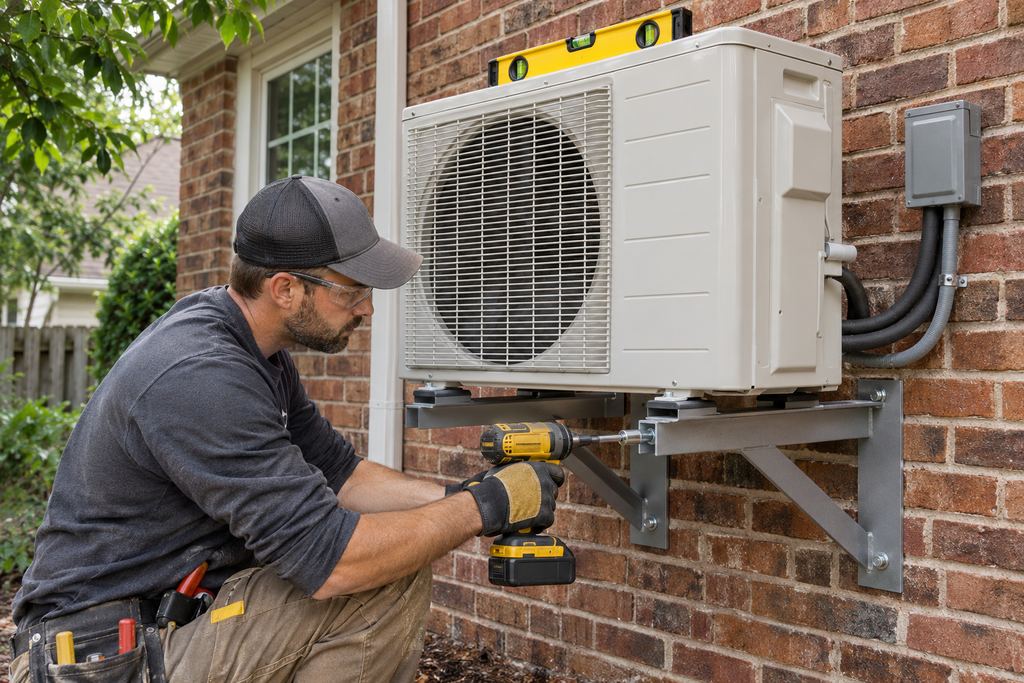
The outdoor unit sits on a pad, a wall bracket or a stand outside. In snowy regions it should be raised above typical snow depth. In hot regions some shade from the afternoon sun helps, as long as airflow around the unit stays clear. Condensate from the head needs a gravity drain to the outside or a pump, and it should not drip onto a driveway where it can freeze.
What sets the price of a garage install
Ask for a written estimate that lists each of these.
Garage conversions and ADUs
Turning a garage into a bedroom, office or accessory dwelling unit changes the rules. The space becomes habitable, so the building department usually requires permits, insulation that meets the energy code and a heating system able to hold indoor temperature. A mini split is a common way to meet that, but the size should come from a load calculation of the finished space, not the garage as it stands today.
Running cost and settings
A garage that is used a few hours a week does not need to be held at 70 degrees around the clock. Many owners set back the temperature when the space is empty and bring it up an hour before use. Some models include a low-temperature heat setting that holds a space around the mid 40s to mid 50s Fahrenheit, which can protect stored items and plumbing at lower energy use. Check whether the model you are quoted has it. In cold climates, ask for the unit's heating output at your winter design temperature, since a garage often has the weakest envelope in the house.
Maintenance you can do and what to leave to a technician
Safe checks you can do
Only checks from the owner's manual that need no tools and no access inside the units.
- Rinse the washable filters often, especially in a dusty workshop. Monthly is reasonable for heavy use.
- Wipe dust off the head's outer surfaces with the unit off.
- Keep snow, leaves and stored items at least a couple of feet from the outdoor unit.
- Check that the condensate line outlet is clear and not frozen.
Leave these to a professional
Refrigerant handling, flaring or brazing the line set, electrical connections and pressure or vacuum tests need a qualified technician.
- Deep cleaning the coil and blower wheel, which collect workshop dust.
- Checking refrigerant pressures and line set connections.
- Inspecting the disconnect, whip and electrical connections.
- Clearing or replacing a condensate pump.
How to vet a garage installer
- 1Can I see your state license number?Look it up on the state contractor board site yourself.
- 2Will you calculate the load for this garage?A quote based only on square footage is a warning sign for a space with an uninsulated door.
- 3Who handles the electrical work and the permit?Get it in writing whether the electrician is included.
- 4Is your crew EPA Section 608 certified?Under EPA guidance it covers any refrigerant work on a mini split, connecting pre-charged lines included.
- 5What does the written estimate include?Equipment model numbers, line set length, drain method, pad or bracket, and removal of packaging and old equipment.
Next steps
For a rough number by area, see what size mini split do I need. The electrical requirements guide explains the circuit and disconnect, and mini split installation cost covers how quotes are put together.
Related pages
Pages that connect to this installation type.
Questions
How much does it cost to install a mini split in a garage?
It depends on the unit size, how far the outdoor unit and panel are from the wall where the head goes, the electrical work, the drain method and permits. Insulation work, if needed, is separate. Get two or three written estimates that list these items so you can compare them line by line.
How big of a mini split do I need for a 24x24 garage?
A 24 by 24 garage is about 576 square feet. As a rough range, an insulated one in a mild climate often lands around 12,000 to 18,000 BTU, and a poorly insulated one or one in a very hot or cold climate can need 18,000 to 24,000 BTU. A load calculation should confirm it.
Can I install a mini split in my garage myself?
Pre-charged DIY kits exist, but they have fixed line lengths and maker-specific warranty conditions, and EPA's homeowner FAQ says connecting pre-charged lines on a mini split requires Section 608 certification. Check current EPA guidance and the model manual before you buy. The dedicated circuit and disconnect still need to meet local code, often with a licensed electrician and a permit.
Is a mini split a good option for a garage?
For a garage used as a workshop, gym or office, usually yes, especially once the door and walls are insulated. It is less useful for a garage that is open to the outside often or that only needs occasional freeze protection.
Can the indoor unit handle car exhaust and workshop dust?
It does not filter fumes, and dust will clog the filter and coil faster than in a house. Place the head away from the tailpipe and dusty work, clean the filters often and schedule coil cleaning.