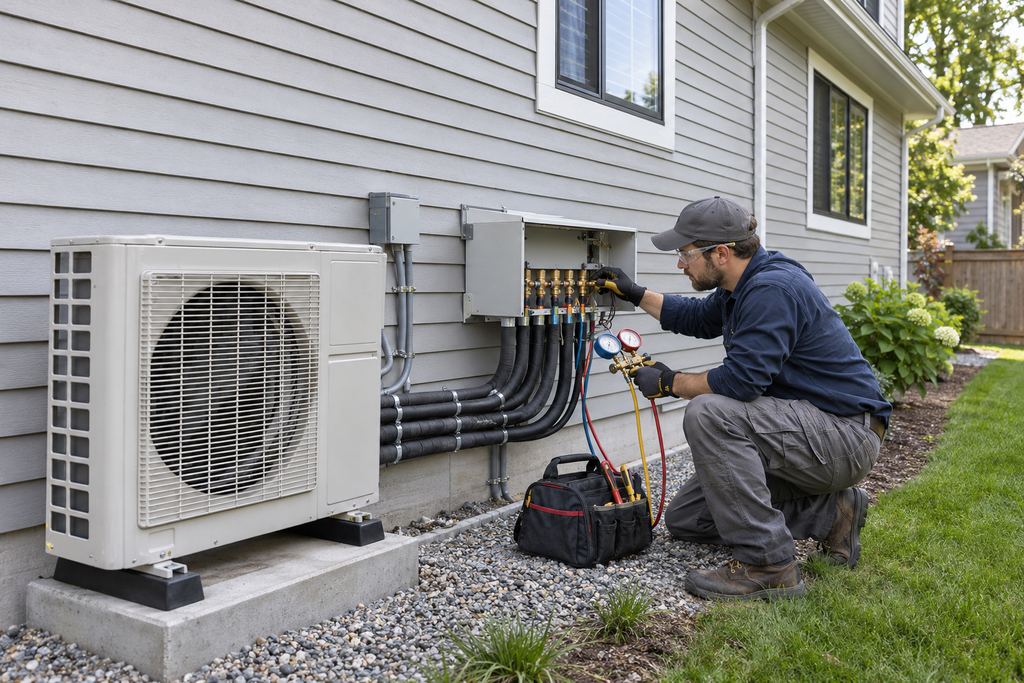
Multi Zone Mini Split Installation
Multi zone mini split installation connects two or more indoor units, each with its own thermostat, to one outdoor unit. It saves wall and yard space and can cost less than the same number of single-zone systems, but it locks every room to one compressor and to the maker's limits on head sizes, combined capacity and line length. A good layout starts with a load calculation for each room.
Sending your request
Please keep this page open. The form is locked so the request is not sent twice.
Your request was received
We passed it to an installer in your area. If one accepts, they contact you using the phone number or email you gave. We cannot say how soon, and you are not required to hire anyone.
No reply after a few days? Check your spam folder, then use the contact page.
How a multi-zone system is put together
The outdoor unit holds one variable-speed compressor. A separate pair of refrigerant lines, a drain and an interconnect cable run from it to each indoor head. Some brands connect each head directly to a port on the outdoor unit, and others use a branch box near the house that splits one main line set into several. Each indoor unit has its own remote or wall control, so a bedroom can sit at 68 while the office is at 74.
Common combinations range from two to five heads on residential outdoor units, with some larger units supporting more. Indoor units can be mixed: a wall head in the living room, a ceiling cassette in the kitchen and a concealed duct unit serving two small bedrooms, as long as the maker lists that combination as approved.
Multi-zone or several single-zone systems
| Question | One multi-zone system | Separate single-zone systems |
|---|---|---|
| Outdoor units on the property | One | One per room or zone |
| If the outdoor unit fails | Every zone loses heating and cooling | Only that zone is affected |
| Small rooms | Limited by the smallest head the line offers | Can use the smallest single-zone size |
| Efficiency at part load | Often somewhat lower when only one small head runs | Each unit matched to its own room |
| Adding a zone later | Only if the outdoor unit has a free port and capacity | Install another system |
| Upfront cost | Often lower for three or more rooms close together | Often lower for two rooms far apart |

Planning the layout
- STEP 1Calculate each roomA room-by-room load calculation gives the BTU for every head. The sizing guide explains the inputs.
- STEP 2Pick head types and spotsWall, cassette, floor or ducted, placed where the air can reach the room and the line set has a sensible path.
- STEP 3Choose the outdoor unitIts capacity has to cover the combined load, and the combination must sit inside the maker's limits for connected indoor capacity.
- STEP 4Check line lengthsMakers cap the length of each branch and the total for all branches, plus the height difference between units. Long runs may need extra refrigerant added on site.
- STEP 5Route lines and drainsLines usually run on the exterior in a cover, through an attic or inside walls. Each head needs a gravity drain or a pump.
- STEP 6Plan the circuitThe outdoor unit takes one dedicated circuit, typically 208/230 volts. See electrical requirements.
Sizing pitfalls with multi-zone
The most common mistake is putting a head that is too large in a small room because it is the smallest size the multi-zone line sells. A 9,000 BTU head in a 120 square foot bedroom will cool it fast, then cycle and struggle with humidity. Options include a ducted unit serving two small rooms, or leaving the small room on a separate small single-zone unit.
The second pitfall is the outdoor unit. Many makers allow the connected indoor capacity to exceed the outdoor unit's rating, on the assumption that not every room calls at once. That works for bedrooms used at night and living areas used by day. It does not work as well if every room needs full output on the same August afternoon. Ask the installer how the combination was chosen and what each head delivers when all are running.
Efficiency and refrigerants
Multi-zone outdoor units are rated with all heads in the system, and their SEER2 and HSPF2 ratings are often a little lower than comparable single-zone pairs. Real efficiency also depends on how the system runs: a large outdoor unit feeding one small head at night works away from its sweet spot. ENERGY STAR lists certified ductless systems, and its rebate finder shows current utility programs. The federal 25C credit no longer applies to equipment placed in service after December 31, 2025, so do not count on it in the budget.
New systems are moving to lower global warming potential refrigerants such as R-32 and R-454B under EPA's technology transitions rules. These are mildly flammable A2L refrigerants with their own handling rules, so ask whether the crew installing your system has worked with the refrigerant it uses.
Maintenance for a multi-zone system
More heads means more filters and more drains to watch.
- Filters in every headRinse washable filters per the manual, often monthly in heavy-use seasons.
- Drain linesA blocked drain on one head can leak into a wall or ceiling. Watch for drips and gurgling.
- Outdoor unit clearanceKeep plants, snow and stored items away so the coil can breathe.
- Professional servicePeriodic coil and blower cleaning on each head, plus a check of line set insulation and connections.
Questions for a multi-zone installer
- 1Is this exact head and outdoor combination approved by the maker?Ask for the combination table or software printout.
- 2What are the branch and total line lengths?Compare them with the maker's limits and ask whether extra refrigerant will be added.
- 3Why this outdoor unit size?Find out how much connected capacity it carries compared with its rating.
- 4Would two single-zone systems do better for any room?A thoughtful installer will discuss it.
- 5What is your license number and who does the electrical?Check the license with your state contractor board and get the electrical scope in writing.
Cost and where to go next
Price climbs with each zone, mostly through extra line sets, wall penetrations, drains and labor, and with the outdoor unit size and brand tier. Line items are explained on the mini split installation cost page. If a detached space such as a workshop is on the list, the garage installation page covers why it is sometimes kept on its own system.
Related pages
Pages that connect to this installation type.
Questions
Can you install a multi-zone mini split yourself?
A few makers sell DIY multi-zone kits with pre-charged quick-connect lines, but line lengths are fixed, warranty conditions vary, and EPA's homeowner FAQ says connecting pre-charged lines requires Section 608 certification. Standard systems also need a certified technician to evacuate and charge the lines, and the electrical work follows local code, often with a licensed electrician and permit.
How many indoor units can one outdoor unit run?
Residential multi-zone outdoor units commonly support two to five heads, and some larger models support more. The maker's specifications give the maximum number of heads and combined capacity.
Should a multi-zone system be sized up to be safe?
Neither is a good plan. On multi-zone systems the usual problem is an oversized head in a small room, which short cycles. Size each head from a room load calculation and choose the outdoor unit for the combined load.
What happens if one indoor unit breaks?
The other heads usually keep working. A failure of the outdoor unit or its compressor, though, takes all zones down until it is repaired.
Which mini split should I not buy for multi-zone?
Avoid any system without local parts support or an installer in your area who services that brand, and any combination the maker does not list as approved. Published capacity data and clear warranty registration terms are good signs.